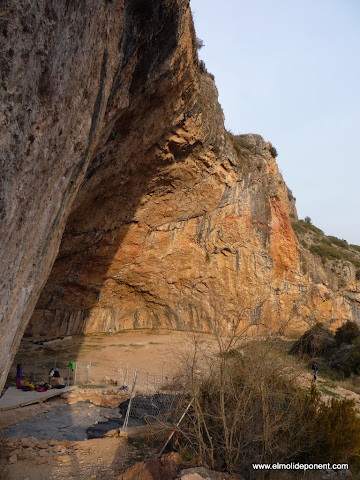
This is an immense shelter of great chromatic beauty, covering 2800 m2 that are disputed by climbers and archaeologists, just as the last Neanderthals and the first Sapiens did thousands of years ago.
According to climbers, it is the best place in the world for sports climbing, as it has a high concentration of challenging routes on high-quality limestone rock. There are 40 routes rated above grade 8, including 7 rated at grade 9. The fact that it often appears in specialized magazines and the frequent presence of media climbers like Chris Sharma attracts people from all over the world, making it a significant tourist attraction for the entire area.
From an archaeological perspective, we have 9 meters of previously unknown strata, discovered in 2002, representing an unprecedented sequence of the last 50,000 years in central Catalonia. So far, according to Rafael Mora, we know that the Neanderthal and the Sapiens coexisted in this cave without biological or cultural mixing.
We hope that this time the actors playing Neanderthals have better luck!

La Linya - the first woman of Noguera
In the 2020 archaeological excavation campaign, remains of a sapiens woman from about 14,000 years ago, from the late Upper Paleolithic period, were discovered. This finding is significant because there are few human remains from this period on the Iberian Peninsula, and it is expected to deepen our understanding of the hunters and gatherers of that time.
The archaeological information sign of Cova Gran


Translated from the Information Panels
The Cova Gran de Santa Linya is located in the middle of a very secluded small valley, formed by the Sant Miquel stream. Despite the apparent isolation of this location within the geography of Noguera, it was inhabited by two hominins: H. neanderthalensis and H. sapiens. This cavity, on the first foothills of the Pre-Pyrenees, preserves evidence of the last 50,000 years of our history.
The Cova Gran allows us to understand the changes in the ways of life of our ancestors, the ancient inhabitants of the Pre-Pyrenees of Noguera, over an extended period. The evidence of these vanished societies is part of the heritage of all citizens. It is the duty of everyone to respect it, protect it, and pass it on to future generations, as it allows us to comprehend how the experience of our human species has evolved over time.
Homo neanderthalensis
The first inhabitants of the cave were groups of Neanderthals, who intermittently settled during their seasonal movements, which defined the hunter-gatherer way of life. Among them, we find rocks made of flint and chert that they used to craft the tools they needed to obtain or transform essential resources, such as food.
Hunting mammals like deer, goats, horses, and bulls, as well as collecting plants and fruits, formed the basis of their subsistence. Fire was a constant in the organization of the social life of these groups.
Cave Engravings
Recent archaeological research has identified five sets of non-figurative engravings on the cave wall: signs, bundles of converging lines, a grouping of shapes, two small grids, and the possible schematic representation of a human figure in the shape of a "Y".
The location of these engravings in relation to archaeological occupations could correlate with the final moments of hunter-gatherer groups that frequented the cave around 10,000 years ago. On the other hand, the bundles of lines and the grids show a wide chronology, ranging from the Mesolithic to the Neolithic, while the "Y" motif is characteristic of the Neolithic.
It is not easy to interpret the meaning of these engravings, but they testify to the presence and influence of prehistoric groups in this cavity over time.
Homo sapiens sapiens
40,000 years ago, a transcendental change occurred: in the cave, we detect the appearance of the first anatomically modern humans. Several phases of these occupations have been recorded, characterized by changes in tools and their craftsmanship, as well as in the way they lived.
They continued to use flint to craft tools, although new instruments made from organic materials such as bone and antler can be detected. Stone tools are now more elongated to facilitate handling, which enabled the emergence of projectiles for long-distance animal hunting.
Fire (3) remained essential, but the shape of the fires changed. They became excavated pits in the ground to better control food cooking and achieve higher temperatures.
Evidence of the use of ornamental elements has also been found, such as marine shells (4) that came from the coast over 150 km away from the cave. This more symbolic aspect is also reflected in engraved bones (5) with geometric motifs and the use of ochre (red pigment), which was likely used both for skin protection and body decoration, possibly as a form of identity expression.
These hunter-gatherer groups were replaced by the first agricultural and pastoral societies around 7,000 years ago. New objects appear, such as ceramic containers and bones from domesticated animals (6), such as goats and sheep, indicating the adoption of a new way of life based on agriculture and animal husbandry.
Throughout this period, the cave was part of a network of settlements related to the transhumance of sheep and goats, connecting the plains of Lleida with the high-altitude meadows of the Pyrenees.


